Governance
Financial Capital, Manufacturing Capital, Intellectual Capital, and Governance by the Musashi Paint Group
For the creation of sustainable corporate value, the Musashi Paint Group is strategically leveraging its financial capital, manufacturing capital, and intellectual capital while taking initiatives to enhance its governance system to ensure appropriate management and control of these capitals.
[Governance Regarding Financial Capital]
- Maintenance of a healthy financial foundation and clarification of investment decisions based on capital costs and risks
- Assurance of reliability of financial reports through internal control and monitoring systems
- Facilitation of a capital policy in aim to enhance medium- to long-term corporate value
[Governance Regarding Manufacturing Capital]
- Optimization of facility investments and establishment of a maintenance system, taking into consideration the overall lifecycle of facilities
- Thorough management of quality, safety, and environment in our production activities
- Organization of a business continuity plan (BCP) and reinforcement of supply risk management
[Governance Regarding Intellectual Capital]
- Strategic protection and utilization of non-tangible assets such as technology, know-how, and branding
- Appropriate management and risk monitoring of intellectual property rights
- Reinforcement of knowledge management to facilitate the sharing and handoff of internal knowledge
- Establishment of governance-enhancing measures for research and development which support the creation of innovation
Our group aspires to develop a sustainable management foundation that is robust to environmental changes and further establish ourselves as a reliable corporation for all of our stakeholders through governance-enhancing initiatives that not only “protect” our capitals but also “leverage” them.
Themes Addressed in Musashi Paint Group’s Governance-enhancing Initiatives
In our governance-enhancing initiatives, we take measures from both financial and non-financial perspectives.
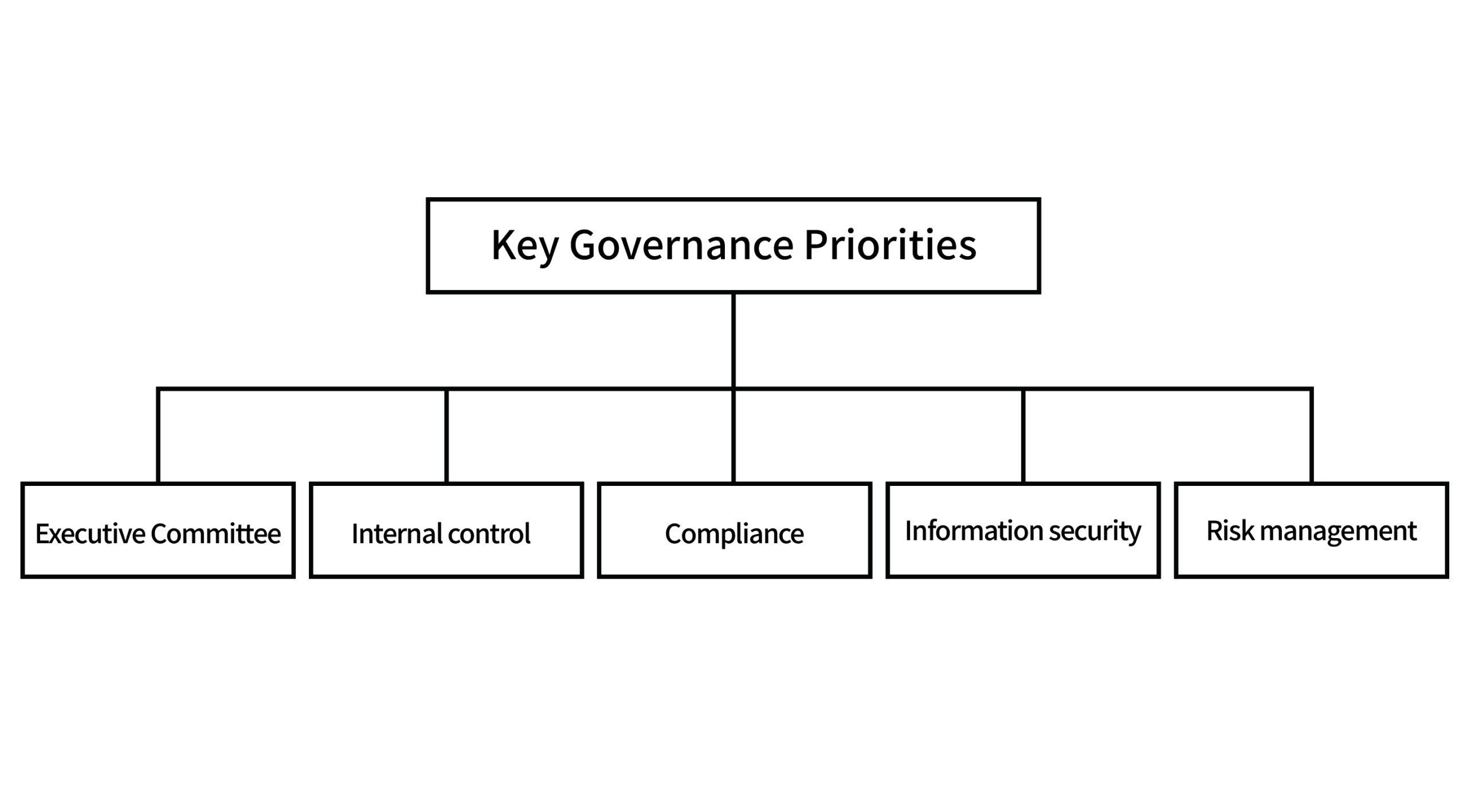
1. Management meetings
Our group divisions work closely with each site to establish a reliable governance system (matrix management).
We focus on management initiatives that emphasize transparency and sustainability, leverage local attributes and diverse perspectives, and fulfill our responsibility to shape the future.
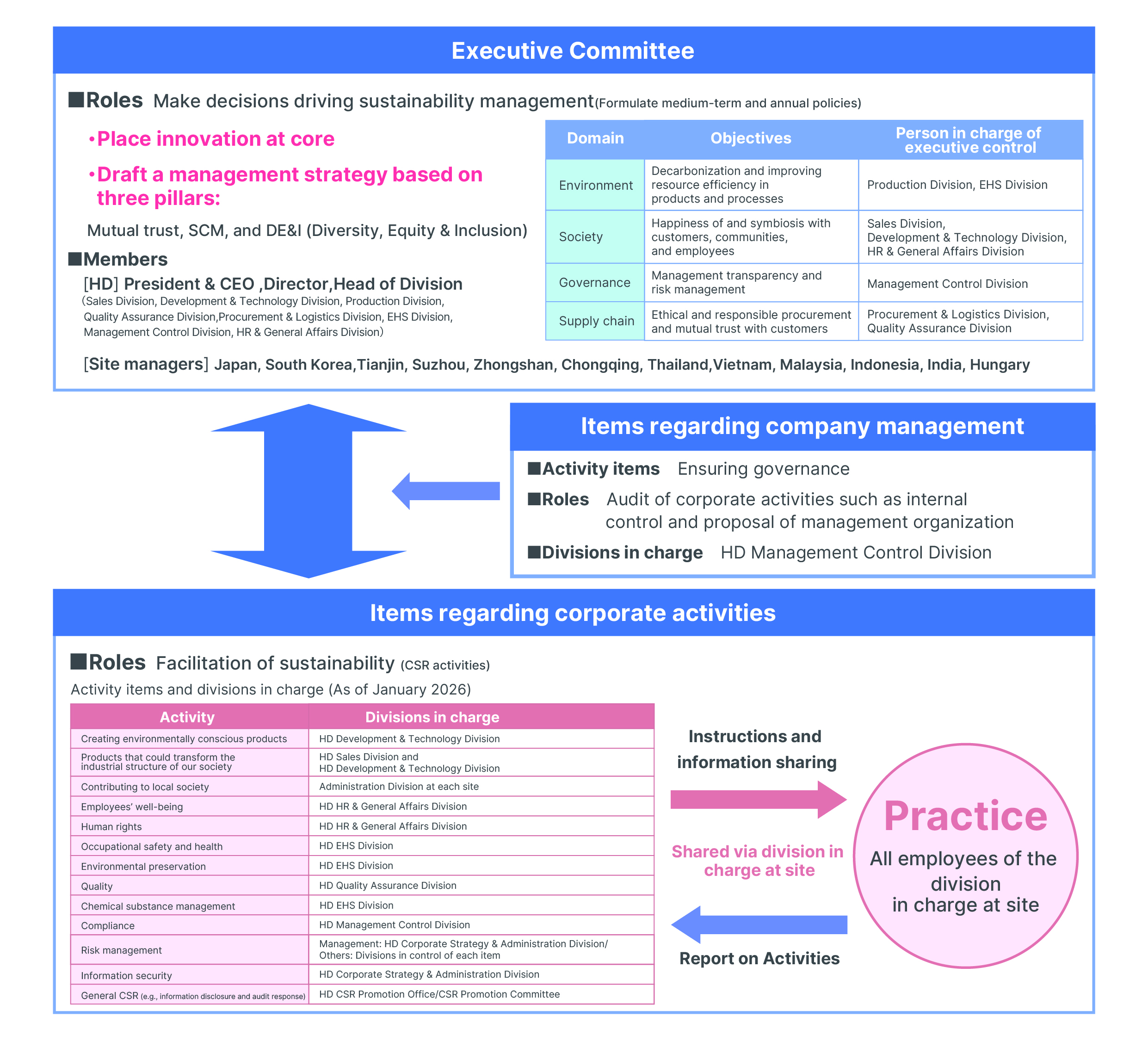
Furthermore, in 2025, the management control division called all heads of divisions, site managers, and some of the younger employees to participate and share new ideas in the formulation of a 3-year medium-term management plan starting from 2026.
2. Internal control
At the Musashi Paint Group, the management control department of the Holding’s management control division leads the initiatives taken for internal control.
We recognize the improvement of operational efficacy and efficiency, assurance of reliability of financial reports, complete adherence to laws and regulations, and preservation of assets as critical management issues. We regularly host walkthrough sessions on internal control for all sites.
The abovementioned activities help us extract improvement matters and continuously monitor sites, enabling us to further reinforce our internal control system. Through the development of a healthy management control system, we aspire to continue creating a sustainable organization that both internal and external stakeholders find to be reliable.
3. Strive for Compliance Reinforcement
At our group, “compliance” not only means “adherence to laws and regulations”, but we also include adherence to social norms and common sense, local practices, stakeholders’ profits and requests, and our company rules.
In a nutshell, we can say that compliance is applicable to all of our corporate activities.
As a member of society, we recognize our responsibilities to adhere to compliance requirements. To strive for compliance reinforcement, we are determined to
- Develop a compliance check system applicable to all group companies by 2030
To achieve the above, we have formulated our “Compliance Policy” as well as secondary documents such as “Operational Guideline for Internal Reporting”, “Operational Guidelines on Fair Transactions”, and “Documentation on Intellectual Property Rights Training”, hosted briefing sessions on these documents, and are taking measures to raise awareness towards compliance across the entire group.
4. Strive to Ensure Information Security
For information security initiatives at our group, we approach both hard and soft infrastructures.
No matter how well the security system may be designed and implemented, if the people handling it lack awareness, then it is more than likely that information will leak to external entities.
We focus on educating each employee to always be careful when handling information.
To strive to ensure information security, we are committed to
- Develop an information security system to prevent information leakages
Specifically, we have formulated our “Information Security Policy”, established the “Operational Procedures for Information Security” as secondary document that supplements this policy, and are making effort to reinforce the group’s awareness towards information security. In the “Operational Procedures for Information Security”, there are procedures outlined for the following 11 items:
| 1. | Rules stipulated by law |
| 2. | Rules to adhere to regarding confidential information |
| 3. | Rules to adhere to regarding user IDs and passwords |
| 4. | Rules to adhere to regarding the use of computer devices |
| 5. | Rules to adhere to regarding the use of the internal network |
| 6. | Rules to adhere to regarding the use of the internet |
| 7. | Rules to adhere to regarding the use of email |
| 8. | Rules to adhere to regarding the use of the production management system |
| 9. | Rules to adhere to regarding hazardous programs |
| 10. | Rules to adhere to when an information security incident occurs |
| 11. | Rules to adhere to regarding awareness |
5. Strive for Risk Management
When conducting corporate activities, we face various risks that may have an impact on our business management.
It is too late when risks become apparent. We must extract potential risks and consider preventative measures we can take.
At our group, we engage in risk management by taking initiatives that minimize impact on business even if risks become apparent.
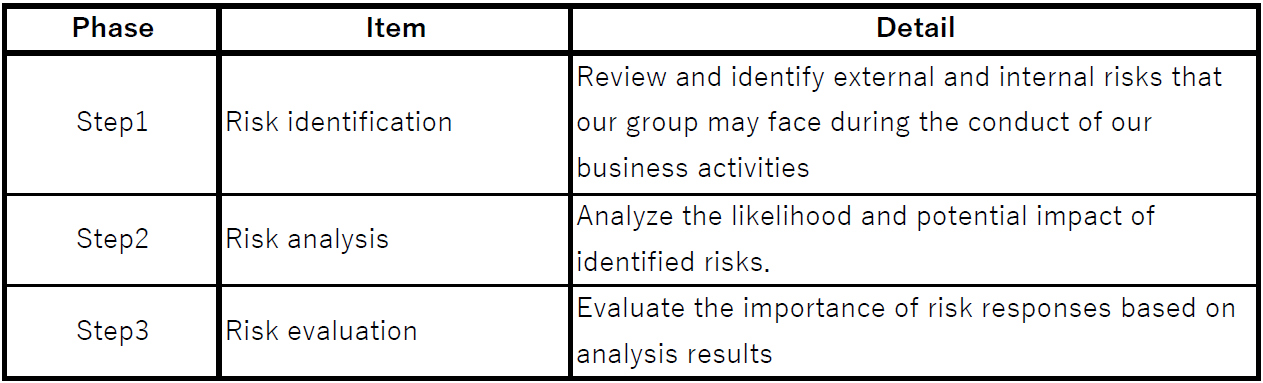
Steps for risk assessment
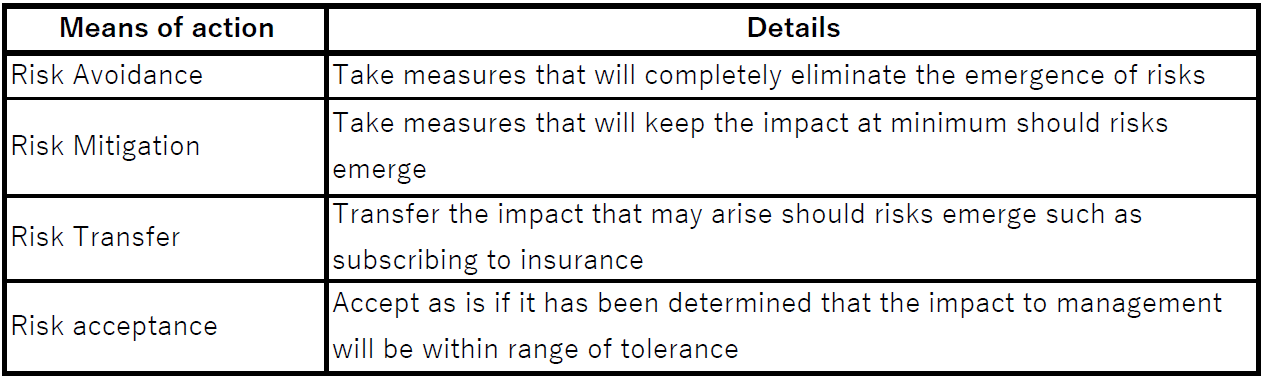
Means to handle risks (Means that should be taken will be determined based on the assessment made in step 3 shown above)
To strive for risk management, we are taking the following measures:
| ① | Extract management risks in accordance with changes in business management and develop a system to execute the designed measures (actions) |
| ② | Strengthen the company’s disaster prevention system |